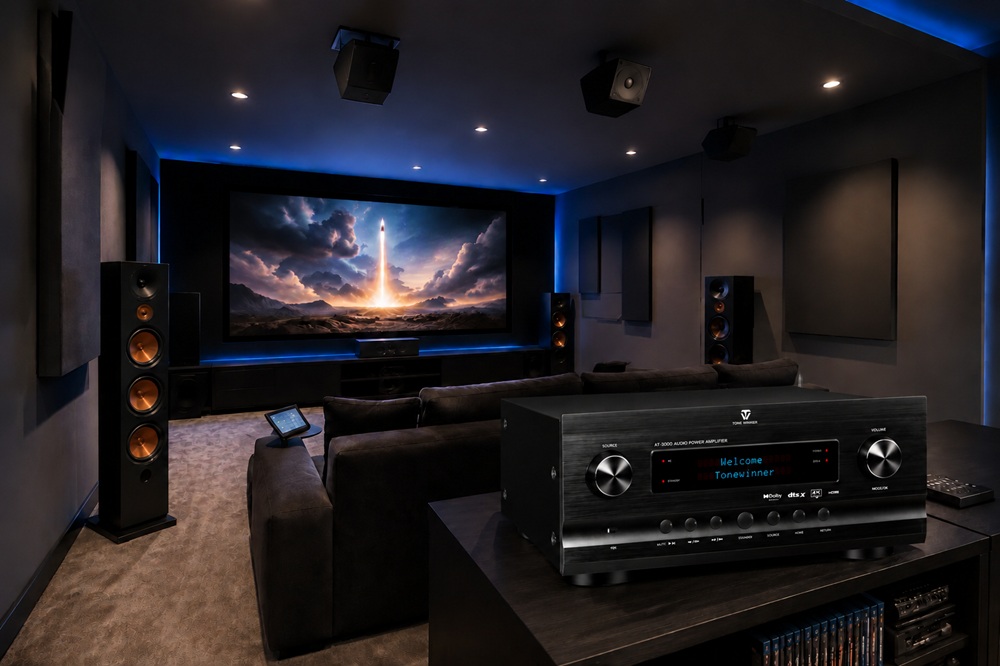
Sie beginnen Ihre Reise zum individuellen Heimkino, indem Sie Ihre Lautsprecherkanäle zählen. Planen Sie ein 5.1.2- oder 7.1.4-Layout? Ihr Receiver muss genau diese Konfiguration bewältigen können. Dieser einzelne Schritt eliminiert die Hälfte der falschen Entscheidungen. Selbst ein Flaggschiff Dolby Atmos AV-Receiver versagt, wenn ihm die richtige Kanalanzahl fehlt.
Verständnis der X.Y.Z-Notation
Dolby Atmos verwendet einen dreistelligen Code, die sogenannte X.Y.Z-Notation. Dieser Code definiert Ihre gesamte Lautsprecherkonfiguration. Die erste Zahl, X, steht für Ihre Surround-Lautsprecher auf Ohrhöhe. Eine 5 bedeutet fünf Lautsprecher um Sie herum. Eine 7 bedeutet sieben Lautsprecher. Die zweite Zahl, Y, zählt Ihre Subwoofer. Die meisten Heimkinos verwenden einen oder zwei Subwoofer für ausgewogene tiefe Frequenzen. Die dritte Zahl, Z, zählt Ihre Höhen- oder Deckenlautsprecher. Diese Lautsprecher erzeugen die vertikale Klangebene, die Atmos einzigartig macht.
Eine 7.1.4-Konfiguration bedeutet sieben Lautsprecher auf Ohrhöhe, einen Subwoofer und vier Höhenlautsprecher. Ihr Receiver muss jeden Kanal in dieser Anzahl verarbeiten und verstärken. Verwechseln Sie nicht Verstärkerkanäle mit Verarbeitungskanälen. Ein 9.2-Kanal-Receiver leitet neun Tonkanäle weiter. Ein 7.1.4-System benötigt elf verarbeitete Kanäle. Richten Sie sich immer nach der Verarbeitungsspezifikation, nicht nach der beworbenen Kanalnummer.
Die zwei beliebtesten Atmos-Layouts für individuelle Heimkinos sind 5.1.2 und 7.1.4. Jedes Layout erfordert eine spezifische Kanalanzahl des Receivers. Für ein 5.1.2-Setup benötigen Sie mindestens einen 7-Kanal-Receiver. Dieser Receiver verarbeitet fünf Lautsprecher auf Ohrhöhe, einen Subwoofer-Ausgang und zwei Höhenlautsprecher. Die meisten Mittelklasse-Receiver unterstützen diese Konfiguration.
Ein 7.1.4-Layout erfordert einen 11-Kanal-Receiver. Dieser Receiver verarbeitet sieben Lautsprecher auf Ohrhöhe, einen Subwoofer und vier Höhenlautsprecher. Diese Fähigkeit finden Sie typischerweise bei High-End-Modellen. Die folgende Tabelle zeigt die ideale Platzierung für Höhenlautsprecher in beiden Konfigurationen.
|
Konfiguration |
Vordere Höhenlautsprecher |
Hintere Höhenlautsprecher |
Mittlere Höhenlautsprecher |
|
5.1.2 |
Direkt über der Hauptsitzposition, im vorderen Drittel des Raumes |
Nicht zutreffend |
N/A |
|
7.1.4 |
60–90 cm vor der Sitzposition |
60–90 cm hinter der Sitzposition |
N/A |
Die Platzierung der Höhenlautsprecher beeinflusst Ihr Atmos-Erlebnis direkt. Befolgen Sie diese wichtigen Regeln von Dolby für die besten Ergebnisse.
Wichtige Platzierungsregeln:
Offizielle Dolby-Spezifikation: Höhenlautsprecher idealerweise 65–100° Trennung (vordere zu hinteren Höhenlautsprechern, gemessen von der Sitzposition aus)
Vielleicht benötigen Sie heute nur ein 5.1.2-System. Aber Ihr Kino wird mit der Zeit wachsen. Kaufen Sie einen Receiver mit mehr Kanälen, als Sie derzeit benötigen. Ein 9-Kanal-Receiver für ein 5.1.2-Setup ermöglicht es Ihnen, später einen zweiten Subwoofer oder zwei zusätzliche Höhenlautsprecher hinzuzufügen. Dieser Ansatz erspart Ihnen den Kauf eines neuen Receivers, wenn Sie ein Upgrade durchführen.
Ziehen Sie einen 9.2-Kanal-Receiver für ein aktuelles 5.1.2-Layout in Betracht. Sie haben dann Spielraum für eine Erweiterung auf 5.1.4 oder 7.1.2. Ein Tonewinner-Receiver bietet ein starkes Preis-Leistungs-Verhältnis bei den Kanälen und eine robuste Verstärkung. Viele Tonewinner-Modelle verfügen über mehr Verarbeitungskanäle als Konkurrenzprodukte in ähnlichen Preisklassen. Dies macht sie ideal für zukünftige Erweiterungen.
Wenn Sie ein voll immersives Heimkino planen, ziehen Sie von Anfang an einen Flaggschiff-Dolby-Atmos-AV-Receiver in Betracht. Diese Receiver unterstützen 13 oder mehr Kanäle. Sie beinhalten eine fortschrittliche Raumkorrektur und Pre-Outs für externe Verstärkung. Sie können mit einem einfachen Layout beginnen und im Laufe der Zeit weitere Lautsprecher hinzufügen. Ein Flaggschiff-Dolby-Atmos-AV-Receiver bewältigt dieses Wachstum, ohne dass ein Austausch erforderlich ist.
Reale Leistungswerte vs. angegebene Wattzahl
Sie sehen einen Receiver, der mit 100 Watt an zwei Kanälen bei 8 Ohm beworben wird. Derselbe Receiver produziert möglicherweise nur etwa 80 Watt pro Kanal, wenn alle sieben Kanäle gleichzeitig betrieben werden. Das Netzteil kann die maximale Ausgangsleistung nicht über jeden Kanal aufrechterhalten. Die reale Nutzung im Heimkino führt oft dazu, dass die verfügbare Leistung pro Kanal sinkt, manchmal drastisch im Vergleich zur groß gedruckten Werbeangabe. Diese Lücke ist für Ihr individuelles Kino von Bedeutung. Unterversorgte Kanäle führen bei anspruchsvollen Actionszenen zu Verzerrungen, Clipping und beschädigten Lautsprechern.
Hersteller messen die Wattzahl unter verschiedenen Bedingungen. Einige bewerten die Leistung mit nur einem angesteuerten Kanal bei 1 kHz mit 10 % Gesamtklirrfaktor (THD). Andere bewerten die Leistung mit zwei angesteuerten Kanälen über den gesamten Bereich von 20 Hz bis 20 kHz bei einem niedrigeren Verzerrungsschwellenwert. Die erste Methode erzeugt eine größere Zahl. Die zweite Methode spiegelt die reale Nutzung wider. Sie sollten immer nach der Angabe für alle angesteuerten Kanäle suchen. Diese Spezifikation verrät Ihnen, wie der Receiver arbeitet, wenn jeder Lautsprecher gleichzeitig Leistung anfordert.
|
AV-Receiver |
Beworbene Wattzahl |
Gemessene / geschätzte Ausgangsleistung bei allen Kanälen |
|
Pioneer Elite VSX-LX102 |
170 W/Kanal, 6 Ohm, 1 kHz, 10 % THD, 1 Kanal angesteuert |
Etwa 60 W/Kanal, wenn alle Kanäle angesteuert werden; 80 W/Kanal bei 2 angesteuerten Kanälen unter realistischeren Bedingungen |
|
NAD T 758 V3 |
110 W bei 2 angesteuerten Kanälen |
66 W/Kanal bei allen angesteuerten Kanälen im Labortest; die vollständige Angabe von NAD für alle Kanäle beträgt 60 W/Kanal |
Diese Tabelle zeigt die wahre Geschichte hinter den beworbenen Zahlen. Ein Receiver, der 170 Watt pro Kanal beansprucht, liefert möglicherweise nur 60 Watt, wenn Sie alle Kanäle ansteuern. Dieser Unterschied beeinflusst Ihre Wahl der Lautsprecher und die Raumgröße. Große Räume mit ineffizienten Lautsprechern benötigen mehr reale Leistung. Kleine Räume mit empfindlichen Lautsprechern benötigen weniger. Passen Sie die Angabe für alle Kanäle an Ihr spezifisches Setup an. Vertrauen Sie nicht allein auf die Zahl für einen einzelnen Kanal.
Tonewinner-Receiver veröffentlichen ehrliche Leistungsspezifikationen. Ihre Verstärkerstufen liefern eine konsistente Ausgangsleistung über alle Kanäle hinweg. Dieser Designansatz gibt Ihnen die Sicherheit, dass Ihr System wie erwartet funktioniert. Ein Tonewinner-Receiver mit einer echten 100-Watt-Angabe für alle Kanäle wird einen Konkurrenten übertreffen, der mit 150 Watt wirbt, aber nur 50 Watt reale Leistung liefert.
Ihr Receiver muss jedes Audioformat in Ihrer Medienbibliothek dekodieren können. Dolby TrueHD und DTS-HD Master Audio sind die verlustfreien Formate auf Blu-ray-Discs. Dolby Atmos und DTS:X fügen diesen Formaten objektbasierte Höhenkanäle hinzu. Ein Receiver ohne diese Codecs kann nicht das immersive Erlebnis liefern, das Sie sich wünschen. Überprüfen Sie das Datenblatt auf jeden Codec beim Namen. Gehen Sie nicht davon aus, dass die Atmos-Unterstützung auch die TrueHD-Unterstützung beinhaltet. Einige Budget-Receiver dekodieren zwar Atmos-Metadaten, verfügen aber nicht über den vollständigen TrueHD-Dekoder.
Streaming-Dienste fügen eine weitere Komplexitätsebene hinzu. Für die volle Kompatibilität mit Streaming-Diensten wie Dolby Atmos-Inhalten von Netflix ist der entscheidende Codec neben Dolby TrueHD und DTS:X Dolby Digital Plus mit Atmos-Metadaten. Streaming-Plattformen verlassen sich auf dieses komprimierte Format, um objektbasiertes, immersives Audio innerhalb von Bandbreitenbeschränkungen zu liefern. Obwohl es das Atmos-Erlebnis unterstützt, bietet es nicht dieselbe Bitrate oder denselben Dynamikumfang wie verlustfreie Formate wie Dolby TrueHD oder DTS-HD Master Audio, die auf physischen Medien verwendet werden. DTS:X ist beim Streaming selten verfügbar, daher ist Dolby Digital Plus der primäre zusätzliche Codec, der für die Atmos-Kompatibilität beim Streaming erforderlich ist.
Sie sollten überprüfen, ob Ihr Receiver Dolby Digital Plus mit Atmos verarbeiten kann. Viele ältere Receiver unterstützen Dolby Digital Plus, aber nicht die Atmos-Metadatenebene. Diese Einschränkung verhindert die Atmos-Wiedergabe von Netflix, Disney+ und anderen Streaming-Apps. Überprüfen Sie die Firmware-Version und die Spezifikationsseite des Herstellers. Ein Firmware-Update fügt diese Unterstützung manchmal hinzu. In anderen Fällen benötigen Sie einen neueren Receiver.
Ein Flaggschiff Dolby Atmos AV-Receiver enthält jeden Codec, den Sie benötigen. Diese Modelle unterstützen Dolby TrueHD, Dolby Atmos, Dolby Digital Plus mit Atmos, DTS-HD Master Audio, DTS:X und oft Auro-3D. Diese vollständige Codec-Suite gewährleistet die Kompatibilität mit jeder Quelle in Ihrem Heimkino. Sie vermeiden die Frustration, dass eine Disc oder ein Stream nicht im vorgesehenen Format abgespielt wird.
Raumkorrektursoftware passt den Klang Ihrer Lautsprecher an die Akustik Ihres Raumes an. Jeder Raum weist Spitzen und Einbrüche im Frequenzgang auf. Wände, Möbel und Raumabmessungen verursachen diese Probleme. Ein gutes Raumkorrektursystem misst Ihre Lautsprecher von mehreren Positionen aus und wendet Filter an, um den Frequenzgang zu glätten. Die drei wichtigsten Systeme sind Audyssey, Dirac Live und YPAO. Jedes verfolgt einen anderen technischen Ansatz.
|
System |
Phasenkorrektur |
Messpositionen |
Plattform |
|
Audyssey MultEQ XT32 |
Minimalphasig |
Bis zu 8 |
Denon, Marantz |
|
Dirac Live |
Gemischtphasig |
Bis zu 9 |
NAD, Arcam, miniDSP, Denon/Marantz (kostenpflichtiges Add-on) |
|
YPAO R.S.C. |
Minimalphasig |
Bis zu 8 |
Yamaha |
Der technische Unterschied, der Dirac von anderen Systemen unterscheidet, ist die Mixed-Phase-Korrektur. Die meisten Raumkorrektursysteme verwenden Minimum-Phase-Filter, die rechnerisch einfacher sind, aber nur die Frequenzamplitude der Raumantwort korrigieren können. Dirac Live verwendet eine Mixed-Phase-Korrektur, die sowohl den Frequenzgang als auch die Zeitbereichseigenschaften des Raums gleichzeitig adressiert. In der Praxis bedeutet dies, dass Dirac das Timing der Bassenergie auf eine Weise korrigieren kann, wie es mit einem reinen Minimum-Phase-EQ nicht möglich ist.
Die Mixed-Phase-Korrektur von Dirac Live macht es zur technisch überlegenen Wahl für Räume, in denen Bassprobleme im Zeitbereich vorhanden sind. Es ist zunehmend in der Produktpalette von Denon und Marantz als kostenpflichtiges Upgrade verfügbar. Wenn Ihr Raum ernsthafte akustische Probleme aufweist, liefert Dirac Live die genaueste Korrektur. Die Verbesserung der Bassklarheit und des Timings ist in Heimkinos mit mehreren Sitzplätzen hörbar.
Audyssey XT32 wendet detaillierte Korrekturfilter im Subwoofer-Kanal mit Filtern in Schritten von etwa 3 Hz an. MultEQ HT kann zwei oder mehr Subwoofer verarbeiten, diese unabhängig zeitlich ausrichten und in der Lautstärke anpassen, um dann den kombinierten Frequenzgang gemeinsam zu entzerren. Obwohl es relativ gut darin ist, den Subwoofer-Frequenzgang über den gesamten Hörbereich hinweg zu entzerren, besteht der Nachteil darin, dass die Varianz zwischen den Sitzplätzen nicht unbedingt verringert wird. Es wendet einfach einen Filter an, der den kombinierten Frequenzgang entzerrt und einen Mittelweg für alle gemessenen Sitzplätze schafft – der nicht unbedingt an jedem Sitzplatz perfekt ist.
YPAO R.S.C. bietet einen einfacheren Ansatz. Es misst bis zu acht Positionen und wendet eine Minimum-Phase-Korrektur an. Das System von Yamaha funktioniert gut für einfache Setups und kleinere Räume. Es fehlt die fortschrittliche Zeitbereichskorrektur von Dirac und die Subwoofer-spezifischen Filter von Audyssey XT32. Für einen dedizierten Kinoraum mit mehreren Sitzreihen kann YPAO an einigen Sitzplätzen einen ungleichmäßigen Bassfrequenzgang hinterlassen.
Ihre Wahl hängt von Ihrem Raum und Ihren Zielen ab. Ein behandelter Raum mit Bassfallen und Akustikpaneelen profitiert am meisten von Dirac Live. Ein typisches Wohnzimmer mit gemischten Möbeln funktioniert gut mit Audyssey MultEQ XT32. Ein einfaches Setup mit einer Hörposition passt zu YPAO. Berücksichtigen Sie die Anzahl der Sitzplätze, die Sie optimieren müssen. Berücksichtigen Sie die Bassprobleme in Ihrem Raum. Wählen Sie dann das System, das diese spezifischen Probleme angeht.
Ihr Receiver fungiert als zentrale Schnittstelle für jede Videoquelle in Ihrem Kino. HDMI 2.1-Eingänge unterstützen 4K bei 120Hz und 8K bei 60Hz. Gamer benötigen diese Eingänge für flüssige Bildraten auf den neuesten Konsolen. Zählen Sie Ihre HDMI 2.1-Anschlüsse sorgfältig. Sie benötigen mindestens zwei oder drei für einen Gaming-PC, eine PlayStation 5 und eine Xbox Series X. eARC (Enhanced Audio Return Channel) sendet unkomprimiertes Atmos-Audio von Ihrem Fernseher über ein einziges Kabel an den Receiver. Diese Funktion macht zusätzliche optische Kabel überflüssig und vereinfacht Ihr Setup. Überprüfen Sie, ob Ihr Receiver Dolby Vision und HDR10+ ohne Qualitätsverlust durchleitet. Ein Flaggschiff Dolby Atmos AV-Receiver enthält mehrere HDMI 2.1-Eingänge und volle HDR-Unterstützung.
Ihr Budget bestimmt, auf welche Funktionen Sie zugreifen können. Einsteiger-Receiver kosten zwischen 400 $ und 700 $. Sie unterstützen 5.1.2-Layouts und grundlegende Raumkorrektur. Mittelklasse-Modelle liegen zwischen 800 $ und 1.500 $. Diese Receiver verarbeiten 7.1.4-Konfigurationen und beinhalten fortschrittliche Raumkorrektur wie Audyssey XT32. High-End- und Flaggschiff-Modelle übersteigen 2.000 $. Sie bieten 11 oder mehr Kanäle, Dirac Live und Pre-Outs für externe Verstärker. Ein Flaggschiff Dolby Atmos AV-Receiver befindet sich in dieser Spitzenklasse. Er liefert jeden Codec, die höchste Kanalanzahl und die beste verfügbare Raumkorrektur.
Mit Pre-Outs können Sie externe Leistungsverstärker an Ihren Receiver anschließen. Diese Fähigkeit ist wichtig für große, individuelle Räume mit ineffizienten Lautsprechern. Ihr Receiver übernimmt die Verarbeitung, während separate Verstärker saubere Leistung an jeden Kanal liefern. Achten Sie bei Mittelklasse-Modellen auf mindestens sieben Pre-Out-Kanäle. Flaggschiff-Receiver enthalten elf oder mehr Pre-Outs. Diese Flexibilität ermöglicht es Ihnen, mit den internen Verstärkern des Receivers zu beginnen und später eine externe Verstärkung hinzuzufügen. Tonewinner-Receiver bieten hervorragende Pre-Out-Konfigurationen zu wettbewerbsfähigen Preisen. Ihre robuste Verstärkung und ehrlichen Leistungsangaben machen sie zu einer klugen Wahl für individuelle Installationen.
Ein Flaggschiff Dolby Atmos AV-Receiver liefert Spitzenleistung für anspruchsvolle Systeme. Halten Sie sich an diese Checkliste. Ziehen Sie Tonewinner für starke Kanal-zu-Preis-Verhältnisse und robuste Verstärkung in Betracht.
Sie benötigen einen 9-Kanal-Receiver für ein 5.1.4-Layout. Diese Konfiguration verarbeitet fünf Lautsprecher auf Ohrhöhe, einen Subwoofer und vier Höhenlautsprecher.
Ja, ein 7-Kanal-Receiver unterstützt 5.1.2 Atmos. Sie erhalten zwei Höhenlautsprecher für Überkopfeffekte. Für mehr Höhenkanäle führen Sie ein Upgrade auf ein 9-Kanal- oder 11-Kanal-Modell durch.
Tonewinner liefert starke Kanal-zu-Preis-Verhältnisse und ehrliche Leistungsangaben. Ihre Receiver beinhalten robuste Verstärkung und Pre-Outs. Sie erhalten Flaggschiff-Funktionen ohne den Flaggschiff-Preis.
Stichworte :
Tel : +86 020 3479 6146
Tel : +86 020 3479 7660
WhatsApp : +86 15812388120
Email : simi@tonewinner.com
Adresse : Building 2, No.1, Hongsheng 3 Road Dashi Street, Panyu District Guangzhou, 511430 China
© 2026 Guangzhou Tonewinner Electronics Co., Ltd
Seitenverzeichnis | XML | Datenschutz-Bestimmungen |