When upgrading your living room audio, one question often comes up: should you choose a soundbar or an AV receiver? Both can make TV and movie audio more engaging, but they are designed for different listening needs.
A soundbar is usually the simpler choice for everyday TV watching, smaller rooms, and cleaner installation. An AV receiver is generally better for people who want a more flexible home theater system, separate speakers, stronger system expansion options, and a more convincing surround sound experience.
So, which one is right for your living room? The answer depends on your room size, listening habits, speaker preferences, and how far you want to take your home entertainment system.
Quick answer: Choose a soundbar if you want better TV sound with minimal setup. Choose an AV receiver if you want a customizable home theater with separate speakers, immersive surround sound, and room to upgrade over time.
The biggest difference is how each system creates and manages sound.
A soundbar is a compact speaker system designed to sit below or near your television. Depending on its design, it may contain multiple speaker drivers, built-in amplification, digital signal processing, and sometimes a separate subwoofer. The goal is to improve TV sound without requiring several individual speakers around the room.
An AV receiver, on the other hand, is the control center of a home theater system. It receives audio and video signals from connected devices, decodes surround sound formats, and sends audio to separate speakers and subwoofers. The speakers can be positioned around the listening area to create a more physical and customizable surround sound environment.
In simple terms, a soundbar combines much of the audio system into a compact unit, while an AV receiver gives you the flexibility to build a system from separate components.
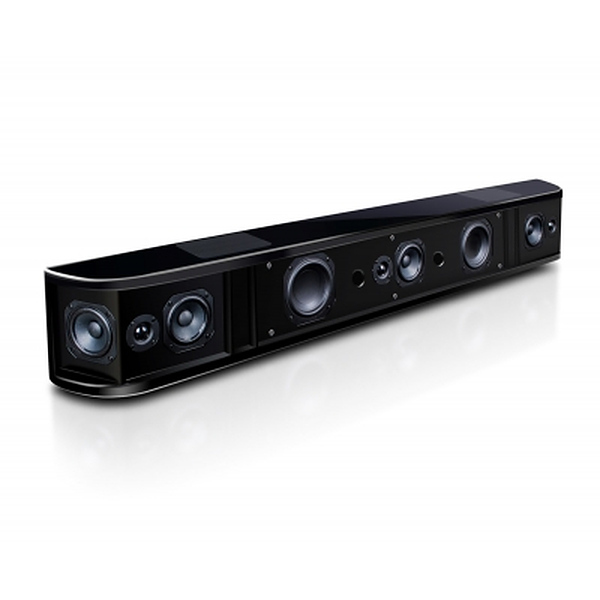
Before choosing a system, it helps to compare the practical differences that matter in a living room.
| Comparison | Soundbar | AV Receiver |
|---|---|---|
| Installation | Usually simple and compact | Requires speaker placement and wiring |
| Speaker arrangement | Integrated speaker design | Separate speakers and subwoofers |
| Surround sound | Depends on virtual or built-in channel design | Supports physical multi-speaker layouts |
| System expansion | Limited by the product design | More flexible and upgradeable |
| Living room appearance | Minimal equipment and cable clutter | More components and placement options |
| Best suited for | Everyday TV and casual viewing | Movies, gaming, music, and home theater |
Neither option is automatically better for every home. A well-designed soundbar can be a very practical solution, while a properly configured AV receiver and speaker system can offer greater control over the listening experience.
A soundbar is a sensible option when convenience matters more than system flexibility. If your main goal is to hear dialogue more clearly, enjoy TV programs, and improve movie sound without rearranging your living room, a soundbar can meet those needs with less equipment.
It is particularly suitable for:
Modern soundbars can also support immersive audio technologies. However, the actual surround effect depends on the number and placement of drivers, signal processing, room acoustics, and whether additional speakers or subwoofers are included.
Tonewinner has a dedicated Soundbar Series for customers exploring compact TV audio solutions. It is a useful starting point if you want to compare soundbar designs for your living room.
If movies are an important part of your home entertainment, an AV receiver offers a different level of flexibility. Instead of relying on a single compact speaker enclosure, you can build a system with dedicated front, center, surround, height, and subwoofer channels.
This matters because surround sound is not only about making audio louder. It is about controlling where sounds come from and how they move around the listening area.
For example, a physical multi-speaker system can reproduce dialogue through a dedicated center speaker, ambient effects through surround speakers, and overhead effects through height channels when the source material and system configuration support them.
An AV receiver is especially worth considering if you:
For these requirements, a dedicated Tonewinner AV Series home theater system offers a more flexible starting point, with AV receivers, amplifiers, processors, and home theater speakers designed for different system configurations.
The main advantage of an AV receiver is its ability to work with separate speakers placed around the room. This gives you more control over the sound field than a compact all-in-one speaker design typically allows.
Consider a movie scene in which a helicopter moves across the screen while dialogue continues and background effects fill the environment. A properly configured surround system can distribute these sound elements across different channels, creating a more convincing sense of space.
With Dolby Atmos and DTS:X compatible equipment, supported content can also include height information. When paired with correctly positioned height speakers, the system can reproduce overhead effects rather than relying entirely on virtual processing.
Of course, the final result depends on more than the receiver alone. Speaker quality, room dimensions, seating position, calibration, and the original audio mix all influence performance.
This is why choosing an AV receiver should be part of planning the complete speaker system, rather than selecting an amplifier based only on its advertised channel count or power rating.
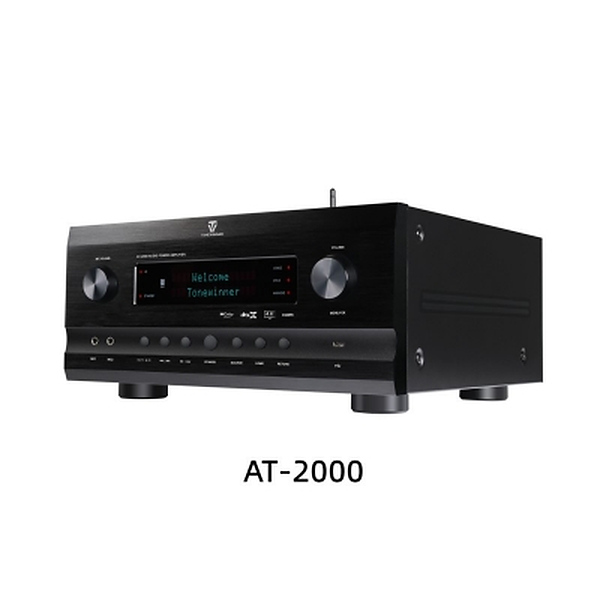
For users who want more than basic TV audio, the Tonewinner AT-2000 AV Receiver is a relevant option to consider.
The AT-2000 supports Dolby Atmos and DTS:X decoding, with a 7.2.4 speaker configuration. It integrates 11 channels of amplification, rated at 160W per channel under the product specification's stated test conditions: one channel driven, 8 ohms, and 1% THD.
For a living room, this means the system can be configured around separate front, center, surround, and height speakers, together with subwoofers. The result is a more configurable home theater arrangement than a typical single-bar setup.
Other useful features include:
The AT-2000 is particularly relevant to households that want one integrated receiver for movie watching and karaoke entertainment. Its room calibration function can help compensate for room-related differences, although good speaker placement remains important.
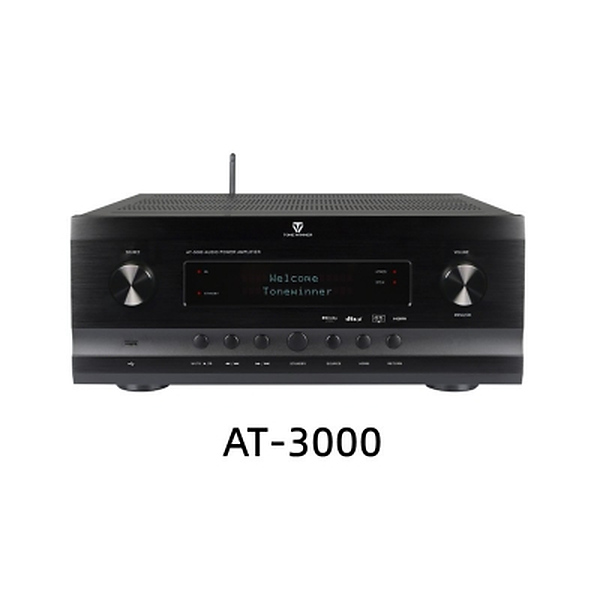
For users planning a more ambitious home theater, the Tonewinner AT-3000 AV Receiver provides a higher level of channel flexibility.
The AT-3000 supports Dolby Atmos, Dolby TrueHD, and DTS:X. Its listed decoding configurations include 7.3.6 and 9.3.4, with 14-channel independent decoding and three subwoofer outputs. It also has 11 built-in amplifier channels.
Its published power specifications include:
The receiver also supports HDMI 6-in/2-out, HDMI eARC, 4K video, HDR, app control, and automatic room acoustic calibration.
One important distinction: the AT-3000's 7.3.6 or 9.3.4 decoding capability does not mean all of those channels are powered by its internal amplifiers. A system using more channels than the built-in amplification supports will require suitable external amplification.
For dedicated movie rooms or larger living rooms where the owner wants to build a more advanced Dolby Atmos system, this flexibility can be valuable.
Room size is an important factor, but it should not be the only one. The layout of the room, distance between the seats and screen, furniture placement, and speaker installation options can matter just as much.
Small living rooms: A soundbar is often the practical choice when space is limited and you do not want speakers or cables around the seating area. An AV receiver can still work in a small room, but it requires careful planning.
Medium-sized living rooms: Both options can work. If you mainly watch TV and streaming content, a soundbar may be sufficient. If you enjoy movies and want distinct surround effects, a multi-speaker AV receiver system is worth considering.
Large living rooms: An AV receiver can offer more flexibility for speaker placement, subwoofer integration, and system expansion. A larger room does not automatically require a high-end receiver, but it makes system planning especially important.
Before buying, measure the listening area and decide where front, center, surround, and height speakers could realistically be installed. This will help you avoid choosing a receiver with more channels than your room can accommodate.
This is where soundbars often have an advantage. A compact soundbar setup may need only a power connection and an HDMI or optical connection to the TV. Some models also include a wireless subwoofer, reducing the number of cables running across the room.
An AV receiver system requires more planning. Each passive speaker needs a connection to the receiver or an appropriate external amplifier. Height speakers and rear surround speakers may also require cable routing through walls, ceilings, or along the room perimeter.
However, this extra work gives you more freedom. You can select speakers based on your preferred sound, change their positions, add a subwoofer, or upgrade individual components without replacing the entire system.
For a cleaner installation, consider speaker locations before purchasing equipment. A carefully planned AV receiver system can still look tidy, even though it uses more components than a soundbar.
Yes. An AV receiver is not limited to movies. It can serve as the central audio hub for music playback, gaming, streaming devices, and other home entertainment sources.
For gaming, a multi-speaker setup can make directional effects easier to follow when the game and audio configuration support surround sound. For music, you can use the receiver with a stereo speaker configuration or a larger multi-channel arrangement, depending on your listening preferences.
The AT-2000 and AT-3000 also support USB and TF card playback, while their broader connectivity options allow multiple source devices to be integrated into one system. The AT-3000 additionally supports HDMI eARC and app control, making it suitable for a more connected home theater setup.
If your system will be used for several purposes, it is worth checking the receiver's input connections, supported audio formats, and speaker configuration options before making a decision.
The right choice becomes clearer when you consider what you actually expect from your living room audio system.
| Your priority | Recommended option | Why |
|---|---|---|
| Simple TV audio upgrade | Soundbar | Compact and straightforward |
| Minimal visible equipment | Soundbar | Fewer separate components |
| Physical surround speakers | AV Receiver | Flexible speaker placement |
| Dolby Atmos home theater | AV Receiver | Supports configurable multi-speaker layouts |
| Long-term system upgrades | AV Receiver | Individual components can be upgraded |
| Movies and karaoke at home | AV Receiver | More control over speakers and audio processing |
If convenience is your priority, a soundbar is a reasonable choice. If you want a system that can grow with your interests in movies, music, and gaming, an AV receiver is usually the more flexible long-term solution.
For customers considering a separate-speaker home theater, Tonewinner's AT-2000 and AT-3000 offer two different levels of system configuration. The best choice depends on the number of speakers you plan to use, your room layout, and whether you need additional external amplification.
A soundbar and an AV receiver solve different problems. A soundbar makes it easier to improve TV sound without adding much equipment. An AV receiver gives you the foundation for a more customizable home theater with separate speakers, subwoofers, and immersive surround sound.
For a simple living room setup, a soundbar may be all you need. For a more serious home theater, especially one built around Dolby Atmos, DTS:X, or future speaker upgrades, an AV receiver is worth the additional planning.
Explore the Tonewinner Soundbar Series for compact TV audio solutions, or consider the AT-2000 and AT-3000 if your goal is a flexible multi-speaker home theater system.
Is a soundbar better than an AV receiver for a living room?
A soundbar is often better for convenience, compact spaces, and simple TV audio upgrades. An AV receiver is generally better for users who want separate surround speakers, more system control, and future expansion.
Does an AV receiver sound better than a soundbar?
A properly configured AV receiver with suitable separate speakers can create a more flexible and convincing surround sound experience. However, the result depends on speaker quality, placement, room acoustics, and system calibration.
Is a soundbar enough for Dolby Atmos?
Some soundbars support Dolby Atmos and use built-in drivers or processing to create an immersive effect. A separate-speaker AV receiver system can provide physical height channels when compatible height speakers are installed.
Is an AV receiver suitable for a small living room?
Yes. An AV receiver can be used in a small room with an appropriately sized speaker configuration. The key is to plan speaker placement and listening distance carefully.
Do I need separate speakers with an AV receiver?
Yes. An AV receiver is designed to power or manage a separate speaker system. The speakers and subwoofers are selected and connected according to the intended home theater layout.
Can I connect my TV to an AV receiver?
Yes. Compatible receivers can connect to a TV through HDMI ARC or eARC. This allows supported TV audio to be sent to the receiver and played through the connected speaker system.
What is the difference between a 5.1.2 and a 7.2.4 home theater system?
A 5.1.2 system generally has five ear-level speaker channels, one subwoofer channel, and two height channels. A 7.2.4 system generally has seven ear-level channels, two subwoofer channels, and four height channels. The additional channels can provide more speaker placement options and a more detailed surround field.
Is the Tonewinner AT-2000 suitable for a home theater?
Yes. The AT-2000 supports Dolby Atmos and DTS:X decoding, a 7.2.4 speaker configuration, and 11 built-in amplifier channels. It also includes HDMI ARC, room EQ calibration, and USB and TF card playback.
What is the difference between the Tonewinner AT-2000 and AT-3000?
The AT-2000 supports 7.2.4 decoding and speaker configuration with 11 built-in amplifier channels. The AT-3000 supports 7.3.6 and 9.3.4 decoding configurations, 14-channel independent decoding, three subwoofer outputs, and 11 built-in amplifier channels. They are designed for different levels of home theater configuration.
Can I upgrade an AV receiver system over time?
Yes. One of the main advantages of an AV receiver system is that you can upgrade individual components, such as front speakers, surround speakers, subwoofers, or external amplifiers, as your needs change. You should check receiver compatibility and available channels before expanding.
Tel : +86 020 3479 6146
Tel : +86 020 3479 7660
WhatsApp : +86 15812388120
Email : simi@tonewinner.com
Adresse : Building 2, No.1, Hongsheng 3 Road Dashi Street, Panyu District Guangzhou, 511430 China
© 2026 Guangzhou Tonewinner Electronics Co., Ltd
Seitenverzeichnis | XML | Datenschutz-Bestimmungen |